Once upon a time, I earned a Master's Degree in Literature and was a Professor of Literature and Composition. I had a wonderful time writing my Master's Thesis about Children's and Young Adult Literature, and I considered earning a Ph.D. so that I could continue to pursue the written word, including British, American, Latin American and other Global Literatures, Children's and Young Adult Literature, all types of genres and occasionally even poetry. But life takes you in unexpected directions, and so now I am working for a non-profit agency (you can read about that on my other blog, A Little Bit of Wonder). Although my job keeps me too busy to post as many book reviews as I would like, Recommended Reading is a place where I can continue to share my literary discoveries and knowledge as time allows.

Please note that I post reviews for books that I recommend reading, just like the blog title says. This means that I typically won't post a review for a book that I completely dislike. This isn't because I shy away from making negative comments, but rather because I don't want to waste your time or mine (I won't even bother to finish a book if it's not any good). For more on this, see the explanation of my Rating System.)


Showing posts with label Time Travel. Show all posts

Wednesday, February 2, 2011

Book Review: Many Waters

Many Waters, the fourth book in Madeleine L’Engle’s Time Quintet, continues to follow the fantastic time/space travel exploits of the Murry family. Instead of focusing on Meg and Charles Wallace, however, this novel is about their “normal” siblings Sandy and Dennys. The twins have always been the ordinary members of the extraordinary Murry family and haven’t taken part in previous adventures, but when they fool around with their father’s computer and inadvertently mess up his experiment with “tessering” through time and space, they suddenly find themselves in the midst of the story of Noah and the Ark, straight out of the Bible. (It’s just like those “Greatest Adventure” cartoons with Derek, Margo and Moki that they used to make us watch in Sunday School!)

Derek, Margo and Moki!

This begins their unbelievable new life in pre-Flood Earth—and by unbelievable, I mean hard for me to believe. I find a lot of elements of L’Engle’s writing difficult to swallow even for Children’s Literature, and this novel is probably my least favorite of the series (although I have yet to read the fifth) in part because the beginning is so badly written. Sandy and Dennys have a very cliché conversation that smacks of speedy, lazy character exposition à la Nancy Drew, the Hardy Boys or the Sweet Valley Twins. Then for no particular reason, the two boys are typing a request into the computer that they be transported some place warmer than the cold New England climate where they live. Magically, the computer is able to comply – and I find myself wishing that going on a vacation to Maui were really that simple. L’Engle tries to explain some of this with a lot of talk about quantum leaps and particle physics, but even in a science fictional world where time/space travel is possible, this all sounds like a load of hooey.

If a reader doesn’t get hung up on these things, though, I admit that there’s a lot of interesting stuff going on in this novel, even though the plot is rather slow. Seraphim and nephilim, creatures which L’Engle developed from a few vague biblical references, live amongst the humans in pre-Flood Earth. At first, it is not clear exactly who or what they are – they are described as beautiful giants with wings that are able to assume animal forms. Neither is it clear whether they are good or evil at first; the race of men know that these creatures are a different species and some consider it to be an honor to be chosen as a mate for these glorified beings. A great deal of tension comes from the interplay between the humans, seraphim and nephilim as some of the characters wrestle with whether to trust the nephilim in particular. Over the course of the novel, it becomes clear that the seraphim are angels and the nephilim are fallen angels, and it is the development of this largely-ignored Biblical mythology that I find to be the most interesting aspect of the novel. Though the nephilim are only mentioned twice in the Hebrew Bible, there is a lot of potential to mine from those brief references.

Sandy and Dennys find themselves amidst the tension between the seraphim and nephalim, as well as the tension between Noah and his father. Though the two boys initially suffer life-threatening heat stroke from prolonged exposure to the desert environs, they manage to help reunite the Biblical patriarch and his stubborn, aging parent – thus securing themselves a place within Noah’s family. Though they miss the rest of the Murrys, who remain back in the twentieth century, they have no idea of how they might return home and so they adjust to life in pre-Flood civilization. They cannot dismiss the nagging question, though, of what will happen to them when the torrential rains come.

As in all of L’Engle’s Time Quintet novels, the journey across time and space is a catalyst for the characters to learn something about themselves and grow into the world around them. Sandy and Dennys are fairly immature and thoughtless at the beginning of the novel, messing with their father’s computer equipment, and they are extremely dependent on each other, functioning as two halves of a whole. Separated while they recover from their heat stoke and severe burns, the two begin to think and operate more independently of one another, and living in the much more harsh environment without the comforts of twentieth century technology forces them to mature in other ways. Finally, while they have generally ignored girls and romance up until this point, they both fall in love with Noah’s youngest daughter Yalith, which becomes another source of tension and a catalyst for further emotional development.

While I found these coming-of-age themes to be interesting, there is a lot of sexual content to this novel that is not present in the first three novels of the Time Quintet. In fact, when reading A Wrinkle in Time, A Wind in the Door and A Swiftly Tilting Planet, I got the distinct impression that L’Engle went out of her way to avoid any overt romantic or sexual activity. Throughout the first two novels, Meg and Calvin’s relationship is referred to as a “special friendship,” and even when they are married and expecting a child in the third novel, Calvin is attending a scientific conference out of the country and Meg is in many ways still characterized as a young and innocent girl. This novel is therefore quite different – the nephilm seduce and marry human women, then have their women try to seduce the twins in order to discover more information about them. Meanwhile, Sandy and Dennys struggle with their attraction to the same young woman throughout the novel. But although I don’t have a problem when books have sexual content, I find it unsettling that a novel written at the children’s level so openly discusses lust and seduction.

Overall, Many Waters was fairly unappealing to me for these reasons; I found the science fiction aspects to be too incredible for readers any older than eight or nine years old, yet the sexual content to be inappropriate (?) for anyone of that age. Yet I will admit that there were enough aspects of the story that I found interesting that by the time I had read two-thirds of the novel, I wanted to see exactly how Sandy and Dennys would escape the Great Flood and return home. The last one hundred pages were more absorbing, and though I can’t really say that I ever became engrossed in the novel, I will say that I can see why some readers would enjoy this story. If you love L’Engle’s other writing, or if you are really interested in the concept of traveling back through time to experience the events of the Bible, then you will probably like this novel well enough. Therefore, I’ll rate it with a "provisional" three stars – a good read for those of you with specific tastes and interests. Generally, though, I consider this to be more of a two star book and for most readers, the novel probably isn't worth your time.

Tuesday, February 1, 2011

Excerpt: The Nephilim

The moon set, its path whiter than the desert sands dwindling into shadow. The stars moved in their joyous dance across the sky. The horizon was dark with that deep darkness which comes just before the dawn.

A vulture flew down, seemingly out of nowhere, stretching its naked neck, settling its dark feathers. —Vultures are underestimated. WIthout us, disease would wipe out all life. We clean up garbage, feces, dead bodies of man and beast. We are not appreciated.

No sound was heard and et the words seemed scratched upon the air.

A scarab beetle burrowed up out of the sand and blinked a the vulture. —It is true. You help keep the world clean. I appreciate you.

And it disappeared beneath the sand.

A crocodile crawled across the desert, lumbering along clumsily, far from its native waters. It was followed by the dragon/lizard, who stretched his leather wings, showing off. A dark, hooded snake slithered past them both.

A small, brown, armored creature, not much bigger than the scarab beetle, skittered along beside the snake. —We are invulnerable. We have survived the fire of the volcanoes, the earthquakes that pushed the continents apart and raised the mountain ranges. We are immortal. We cover the planet.

A bat, brighter than gold, swooped low over the cockroach. —You are proud, and you can survive fire and ice, but I could eat you if I had to. I hope I never have to.

And the golden bat soared high, a bright flash against the dark.

A tiny mimicry of a crocodile, with a blunt nose, a skink scrabbled along beside the crocodile and the dragon/lizard. —I am small, and swift, and my flesh is not edible and causes damage to the brain. I am the way that I am. THat is how I am made.

On the skink's back, a flea tried to dig through the armored flesh. —I, too, am the way that I am.

A shrill whine cut across the clear air. A mosquito droned. —I, too. I, too. I will feast on your blood.

A small, slimy worm wriggled across the sand, leaving a thin trail. A slug's viscous path followed. —I am not like the snail, needing a house. I am sufficient unto myself.

A red ant crawled along the dragon/lizard's wing, and held tight as it tried to shake the biting insect off. A rat, sleek and well filled, wriggled its nose and whiskers and looked at the vulture's naked neck. —I, too, eat the filth off the streets. I eat flesh. I prefer living flesh, but I will take what I can get. I, too, help keep the world clean.

No sound was heard. Like negative light, the words cracked the desert night.

The twelve oddly assorted creatures began to position themselves into a circle.

The nephilim.


(Excerpt from Madeleine L'Engle's Many Waters, Chapter 5: The Nephilim.)

I am reading Many Waters by Madeleine L'Engle as part of my review series on her Time Quintet, and I am not sure whether or not I like this book at all. I'm really drawn to this passage, though. What do you all think of it? Are there any regular readers of Sci-Fi/Fantasy who can comment?

My full review of Many Waters will be posted tomorrow.

Tuesday, January 25, 2011

Book Review: A Swiftly Tilting Planet

After reading my review of A Wrinkle in Time, several people have mentioned to me that they have never gotten around to finishing all five novels in Madeleine L’Engle’s Time Quintet. Having just finished A Swiftly Tilting Planet, I want to urge readers to return to this series specifically to enjoy this third novel; in my opinion, it is even better than the first two. While A Wrinkle in Time and A Wind in the Door both talk a great deal about how everything in the universe is interconnected, a lot of the plot twists in these two books seem simplistic and somewhat arbitrary. Many story elements lack a believable explanation – or any explanation at all. It often seems to me that L’Engle did not have explanations for many of the events in her own novels, and that she relied too heavily on the repeated declaration that humble creatures such as humans and angels cannot fathom all the ways of the Universe.

In A Swiftly Tilting Planet, though, L’Engle weaves a much more complex story that illustrates the interconnectedness of all people and things. Charles Wallace Murry, the especially intelligent and intuitive child from the first two novels, is now fifteen years old and must travel back and forth through time in order to discover and influence how the descendents of two intertwined families effect the fate of the modern world. Riding on the back of the unicorn Gaudior, the Wind blows Charles Wallace from the communities of ancient Native American and Puritan Welsh settlers to his own home town only a generation previous to his own, then back again to the time of the American Civil War. He is blown from his home on the East Coast to planets unnamed, then down to a fictional country in Patagonia, the southern-most portion of South America.


As Charles Wallace and Gaudior are blown from place to place, back and forth across time, they are repeatedly attacked by the Echthroi, fallen angels who are the source of all pain and destruction. The Echthroi wish to keep Charles Wallace from reliving and changing events from the past, events that will prevent the birth of a cruel South American dictator now threatening to destroy Charles Wallace’s present world. Despite the violent assaults of the Echthroi, Charles Wallace must “go Within” many of the members of the Maddox and Llawcae families in order to help them make a series of crucial decisions and restore the balance of good in the world.


The way that L’Engle has Charles Wallace moving back and forth through time – not simply going all the way back and then reliving each generation in chronological order – creates added mystery and tension in the novel. It is much easier to swallow Gaudior’s declarations that humans and unicorns are too humble to understand the ways of the Wind and the Universe because ultimately, the jumbled order in which Charles Wallace must experience events in the Maddox and Llawcae family trees comes to make sense. He must unravel one piece of the mystery and understand certain events before he is able to travel even further back in time to influence other things, but in the end, all comes out right.

Charles Wallace’s success is particularly due to a rune, a magical verse of ancient origin which had been passed down through generations. It is Mrs. O’Keefe, the mother-in-law of Charles Wallace’s sister Meg, who first recites the rune and bestows it upon Charles. He is then able to use it at key times throughout the novel, calling upon the power of Heaven and the universal elements to come to his aid:

At Tara in this fateful hour,
I call on Heaven with its power,
And the sun with its brightness,
And the snow with its whiteness,
And the fire with all the strength it hath,
And the lightning with its rapid wrath,
And the winds with their swiftness along their path,
And the sea with its deepness,
And the rocks with their steepness,
And the Earth with its starkness,
All these I place
By God's almighty help and grace
Between myself and the powers of darkness!

Cleverly, L’Engle also uses the rune to structure the novel itself – each chapter is named for a line of the verse and deals with a specific element. This adds structure to the chaotic way that Charles Wallace and Gaudior go hurtling across time, balancing the confusion of the characters with a sense of underlying order – the order and purpose that Gaudior adamantly maintains does indeed exist, even if he and his young human friend cannot see or understand that order. There is beauty to be found in this tension between the seen and the unseen.

Because the events of the novel seem much more logically plotted and explained, I find the conclusion of this novel to be much more satisfying than the first two in the series. I was surprised at how much I enjoyed reading A Swiftly Tilting Planet and recommend it even for readers who have not picked up A Wrinkle in Time and A Wind in the Door. While it builds upon the previous two novels, first-time readers can also follow the story of Charles Wallace and Gaudior, the Maddox and Llawcae families without knowing much about the events of the past two books. I would imagine that almost anyone would enjoy trying to unravel the mystery of these two family trees, a mystery which spreads across generations and has incredible influence on the fate of the whole Earth. With this book, L’Engle clearly illustrates the interconnectedness of all people, something which she extols throughout her series, and emphasizes that despite our individuality, each of us is part of something greater.


Sunday, January 23, 2011

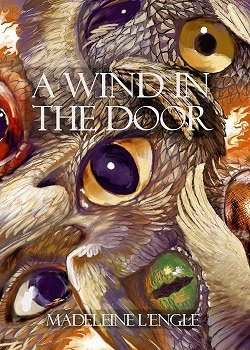
Book Review: A Wind in the Door

“There is war in heaven, and we need all the help we can get. The Echthroi are speeding through the universe. Every time a star goes out another Echthros has won a battle. A star or a child or a farandole—size doesn’t matter…the balance of the entire universe can be altered by the outcome.”

In the Newberry-winning novel A Wrinkle in Time, Madeleine L’Engle introduced readers to Meg Murry, her younger brother Charles Wallace, and their friend Calvin O’Keefe when the three were called upon to rescue Meg’s father from a monstrous, disembodied force that sought to absorb all creatures with free will. Now, in the second book of L’Engle’s Time Quintet, Meg and Calvin are once again visited by magical beings that need their help—this time to save Charles Wallace’s life.

L’Engle’s novels are often categorized as fantasy, but contain an interesting and unusual blend of science/sci-fi and spirituality; A Wind in the Door is no exception. Drawing from the Bible, L’Engle introduces the concept of the Echthroi—fallen angels who are the major destructive force in the universe. They are ripping holes in the sky, spreading darkness and nothingness, and they are responsible for Charles Wallace’s growing weakness and palor as well.

At the beginning of A Wind in the Door, it is revealed that the extremely intelligent and intuitive Charles is steadily growing more and more ill; his mother, who is a renowned biologist, believes that his illness has something to do with his mitochondria. She sets to work in her lab, trying to understand his condition, while Charles and Meg’s physicist father is away consulting with other scientists about some potentially dangerous occurrences in outer space. L’Engle uses these circumstances to place the children in a typical situation of Children’s Literature: because of their parents’ limited understanding and availability, the responsibility to save Charles Wallace falls to Meg and Calvin.

Thus begins the adventure narrative, which involves fighting the agenda of evil spiritual creatures with both the knowledge of science (or rather, L’Engle’s version of science) and the great power of love. I’m not really fond of the author’s reoccurring love-conquers-all message; it’s a little too simplistic, even for Children’s Literature. But I enjoy that the cheribum Proginoskes is also based on a creature from the Bible—the many-winged, many-eyed seraphim in Isaiah.

Proginoskes is sent to partner with Meg; together, the two must face three tests in order to defeat the Echthroi and save Charles Wallace. Although Calvin and several others will play a role as well, Meg and Proginoskes must make a special connection—something that is difficult for Meg at first because of the cheribum’s alarming appearance. But she must learn to trust and love Proginoskes in order to save her little brother; she must learn to “kythe” with him, which is essentially a type of telepathic communication. For the sake of Charles Wallace, Meg must open herself up to a creature that is terrifying in appearance and seems wholly unlike herself.

While re-reading the first two novels in L’Engle’s Time Quintet, it occured to me that Meg is something of a weak and immature character, always wishing that someone else would come along and save the day. This bothered me as I was reading, doubly so because this female character was created by a woman. I want my female characters to be strong and heroic, but Meg is rather snively and whiny, always crying and hiccupping, then having to polish her glasses once they’ve become streaked with her tears. She is often both frightened and frustrated, and always wants a male to come in and take the lead. In A Wrinkle in Time, she is at first convinced that if she and the others can just find her father, Dr. Murry will be able to set everything right, and she is painfully disappointed when he isn’t capable of facing the monstrous IT in order to save Charles Wallace. In the end, it is she who has to return to the planet Camazotz to rescue her brother. Even after this empowering experience, though, Meg continues to be a very anxious and hesitant person, often wishing for the comforting presence of her sort-of-boyfriend Calvin. In A Wind in the Door, she also wants the Teacher Blajeny to handle the Echthroi, instead of having to face the three tests with Proginoskes. To be fair, I wouldn’t want to face off with fallen angels either, but I still found myself wishing for a slightly more stalwart heroine.

I also realize, though that Meg’s weakness is essential to the story – because A Wind in the Door is not simply about saving Charles Wallace, but about how our heroine must overcome her selfishness and immaturity in order to defeat the Echthroi. Meg, who is so often misunderstood by her peers and teachers, must learn to love others who are very different from her—both Proginoskes and the disagreeable Mr. Jenkins—in order to partner with them. Although an adolescent’s typical desire is to first be understood by others, Meg must overcome that desire; she must be the mature one who reaches out to understand those around her. Once she is able to look past her own prejudices and love those that at first seem unlovable, a more mature Meg must then help Calvin and Proginoskes convince another young character to “deepen”—another word for his species’ maturation. Charles Wallace’s survival and recovery ultimately depends on the willingness of both Meg and this secondary character to accept the responsibilities of an adult, whether or not they feel that it is time to grow up.

The novel is steeped in the language and trappings of sci-fi, which I must admit that I find less easy to swallow than pure fantasy for some reason. I find L’Engle’s descriptive imagining of the world inside a mitochondrion to be quite beautiful, but the fact that a great amount of the novel is spent explaining this and that pseudo-scientific concept can become quite a drag, too. And as I already stated, the “love connects the entire universe” and “love conquers all” messages are a little too simplistic and touchy-feely for me to enjoy L’Engle’s novels as much as I enjoy Lewis’s Chronicles of Narnia. (I can’t help but continue to compare the two.) Ultimately, though, I really appreciate the way that L’Engle forces the characters to accept responsibility for more than themselves. Whenever I read The Time Quintet, I find myself chafing though most of the novel, then suddenly having an “ah-ha!” moment and being glad that I read the book. So don’t let my bit of bah-humbug stop you from reading A Wind in the Door—especially if you enjoy science fiction. Even if you don’t, it’s still a great read for kids and even a fairly enjoyable one for adults.

Thursday, January 20, 2011

Book Review: A Wrinkle in Time

While I eagerly wait for Amazon to deliver my copy of 2011 Newbery winner Moon Over Manifest, it feels like an appropriate time to review a few other recipients of that award. Because When You Reach Me, the 2010 recipient that I reviewed on January 16, directly references Madeleine L’Engle’s Newbery-winning A Wrinkle in Time, I thought it would be fun to re-read and review it, along with the rest of L’Engle’s Time Quintet.

A Wrinkle in Time begins very much like many other children’s adventure stories: with an unhappy adolescent. Meg Murry feels unattractive with her braces and glasses, her grades are steadily dropping, and she’s getting into fights at school. Her father went away on a business trip and never came back, and now rumors are flying around town that Dr. Murry has deserted his family for another woman – an idea that Meg knows just isn’t true. Dr. Murry is a famous physicist who works for the government; she believes that he has disappeared because something awful happened to him while he was performing experiments. With all these concerns weighing on her mind, Meg is entirely miserable, and readers will empathize with how difficult her life has become. One scene from the novel that I particularly appreciate is the confrontation that the stubborn Meg has with her principal; you get the sense that perhaps the man might have good intentions, but that Meg is so used to dealing with people who want to ridicule her that she can no longer accept help or friendship from anyone outside of her family.

Then one day, three magical beings calling themselves Mrs. Whatsit, Mrs. Who and Mrs. Which arrive to inform Meg and her gifted little brother Charles Wallace that their father is in serious danger. There is a mysterious shadow that is taking over different worlds in their enormous universe, and Dr. Murry has been imprisoned by this dark force; the three strange messengers have come to transport Meg, Charles Wallace, and their new friend Calvin off on a journey to rescue her father. After traveling from planet to planet and witnessing for themselves the way that the shadow is advancing upon various worlds, they arrive on the planet Camazotz, unsure of how to free Dr. Murry and by determined to prevent the shadow from swallowing Earth.

This is, of course, a rather blatant religious message—the dark shadow, creeping across the surface of the planet and overtaking the hearts and minds of each person, is clearly a depiction of spiritual evil: “Above the clouds which encircled the mountain, [Meg] seemed to see a shadow… she knew that there had never been before or ever would be again, anything that would chill her with a fear that was beyond shuddering, beyond crying or screaming, beyond the possibility of comfort.”

But although several characters make a habit of quoting the Bible, this novel isn’t your run-of-the-mill Christian allegory. Most notably, A Wrinkle in Time does not directly represent God or Christ, the savior of mankind. Throughout such novels as C.S. Lewis’s The Chronicles of Narnia, for example, the Lion Aslan symbolizes both God the Father and Jesus Christ at different times, and his help is absolutely necessary for his subjects to conquer the forces of evil. But in A Wrinkle in Time, Mrs. Whatsit and her companions only deliver the children to the planet Camazotz and then inexplicably cannot remain there with them. Meg, Charles Wallace and Calvin must act on their own to save Dr. Murry and defeat the monstrous IT. This suggests that a savior is not necessary for spiritual redemption, and many traditional Christians have rejected L’Engle’s novels because her writings are infused with unorthodox beliefs like these.

Although these spiritual concepts are the foundation for many of the characters’ actions in A Wrinkle in Time, you do not have to be a religious person to enjoy this novel. The story is a sufficient combination of sci-fi, fantasy and spirituality to be an entertaining adventure narrative. There are also some insightful moments, such as the passage where Meg must try to explain the concept of seeing to some sightless creatures:

“What is this dark? What is this light? We do not understand. Your father and the boy, Calvin, have asked us [about these things], too. They say that it is night now on our planet, and that they cannot see. They have told us that our atmosphere is what they call opaque, so that the stars are not visible, and then they were surprised that we know stars, that we know their music and the movements of their dance far better than beings like you who spend hours studying them through what you call telescopes We do not understand what this means, to see.”

“Well, it’s what things look like,” Meg said helplessly.

“We do not know what things look like, as you say,” the beast said. “We know what things are like. It must be a very limiting thing, this seeing.”

Just as with this conversation, Meg and her traveling companions encounter several beings who help them to understand their universe in different ways; these are not only insights that they need to complete their rescue mission, but to live more wisely on their own planet once they return home.

But although I enjoy these elements of the story, I must confess that some of the novel’s events seem contrived to me and the characters are not as well-developed as I would personally prefer. The depiction of IT as a writhing, seething out-of-body brain and the love-conquers-all message are both a bit too much for me to swallow with a straight face. (Not to mention that in this latest re-read, I kept picturing the extremely intelligent and well-spoken five-year-old Charles Wallace as Stewie from Family Guy, which was more than a little bit disquieting.) So although this childhood favorite is often enchanting, A Wrinkle in Time sometimes falls a little flat for me in comparison to Lewis’s Chronicles of Narnia. That could also be because I grew up reading and re-reading Lewis’s series and didn’t discover L’Engle until I was nearly twenty years old, though. I can certainly see how and why this novel could be an engrossing and magical experience for many readers, so although it is not one of my absolute favorites, I would recommend checking it out, particularly if you have an interest in novels about time travel.


Note: this post participates in the Weekly Geek January 14, 2011 Challenge.

Sunday, January 16, 2011

Book Review: When You Reach Me

Note: While I’m eagerly waiting for Amazon to deliver my copy of the 2011 Newbery award winner Moon Over Manifest, I thought it would be an appropriate time to review a few other Newbery winners, starting with last year’s recipient. Enjoy!

Career changes. Job interviews. Performance reviews. Tax Forms. Most of us would probably agree that every once in a while, it would be nice forget all of our grown-up concerns and be absorbed in the problems of a twelve year old again, even if just for a little while. If you’re an adult reading Rebecca Stead’s When You Reach Me, the recipient of the 2010 Newbery Award for Children’s Literature, that is one of the many pleasures of the novel—it is a well-written account of pre/early teen life that reawakens your memories of misunderstandings between friends, subtle and confusing competition for a boy’s attention, unexpected and perplexing rejection, and a growing awareness of socio-economic differences.

If you are a young adult reading the novel, you cannot help but feel an affinity with the narrator Miranda, who looses her childhood best friend, dislikes a classmate without really understanding why, finds herself frustrated with her quirky single mom, and discovers that she has a crush on the same boy as her new best girlfriend. As Miranda struggles to understand these experiences, the reader is drawn into the complexity of her emotions, all the more poignant because she does not state her feelings in the overly-dramatic terms that some teen literature employs.

What makes this novel even more entertaining and powerful, though, is that it does not focus solely on the dramas of early adolescence. Rather, it weaves them into the story of a mysterious series of letters that an unknown person leaves for Miranda—a set of clues without any comprehensible explanation of where the clues will lead. These cryptic notes frighten Miranda because the author has broken into her home to leave her the letters, seeming to take nothing but still threatening her sense of safety. The intruder’s messages also tell her that someone’s life is in danger—but that she must tell no one, only follow his directions. Miranda’s narrative references to the letter-writer are a bit too vague at first and might confuse the reader, but as her adolescent turbulence and fairly normal sense of isolation are heightened by these strange and frightening letters, the reader is drawn into a mystery that grows more and more absorbing.

The novel is peppered with descriptions of Miranda’s favorite novel, the 1963 Newbery winner A Wrinkle in Time by Madeline L’Engle, which point early on in the story to Stead’s own upcoming fantastic conclusion. L’Engle’s novel is all about time travel, and as Miranda struggles to understand theories about time as a loop and time as a construct, the reader is given more and more clues as to how the mysterious notes have been delivered. It is not until Miranda actually witnesses an accident involving her friend, though, that she can truly understand the import of the notes and shake off her fear of their author. Through this process, she becomes a more compassionate person, learning to understand the value in the people around her—even the ones that seem strange or frightening.

Readers will enjoy Miranda’s perceptive and compelling descriptions of her home life and her many experiences through the fall of 1978 and spring of 1979. Though for short parts of the story, the time-travel plot does not appear to be moving forward in any discernable way, the narrator’s account of daily events are still significant in the life of a 6th grader, and readers are immersed enough in Miranda’s problems that they will not loose interest. Overall, the novel is an astute and sincere exploration of how adolescents must learn to “lift the veil” that is draped in front of their faces and discover the reality of the strange, complicated world around them. It is a novel worthy of comparison to its predecessor, L’Engle’s 1963 classic.

Note: this post participates in the Weekly Geek January 14, 2011 Challenge.
Related Posts Plugin for WordPress, Blogger...