Once upon a time, I earned a Master's Degree in Literature and was a Professor of Literature and Composition. I had a wonderful time writing my Master's Thesis about Children's and Young Adult Literature, and I considered earning a Ph.D. so that I could continue to pursue the written word, including British, American, Latin American and other Global Literatures, Children's and Young Adult Literature, all types of genres and occasionally even poetry. But life takes you in unexpected directions, and so now I am working for a non-profit agency (you can read about that on my other blog, A Little Bit of Wonder). Although my job keeps me too busy to post as many book reviews as I would like, Recommended Reading is a place where I can continue to share my literary discoveries and knowledge as time allows.

Please note that I post reviews for books that I recommend reading, just like the blog title says. This means that I typically won't post a review for a book that I completely dislike. This isn't because I shy away from making negative comments, but rather because I don't want to waste your time or mine (I won't even bother to finish a book if it's not any good). For more on this, see the explanation of my Rating System.)


Showing posts with label Madeleine L’Engle. Show all posts

Saturday, March 19, 2011

"Duel Perspective": Madeleine L'Engle and Feminism

Welcome to Part Two of Little Wonder’s first “Duel” Perspective. The idea is that I debate with a guest book blogger on the subject of a particular book and/or author. I’m deeply indebted to Enbrethiliel (Cristina) from Shredded Cheddar for helping me develop the idea, and for participating in the opening debate.

Here you’ll find both my thoughts and Enbrethiliel’s as we duel on the subject of Children’s/YA author Madeleine L’Engle (best known for A Wrinkle in Time). This is a particularly great subject to be debating during Women's History Month!

If you’re interested in reading more of our opinions on L'Engle, check out part one of my “duel” with Enbrethiliel and my reviews of L’Engle’s individual novels, all in the L’Engle archive.

Little Wonder’s take: Having read four of the Time Quintet and only one of the Austin Family Chronicles, my perspective of L’Engle’s female characters is admittedly somewhat limited. (Confession: I couldn’t even finish An Acceptable Time, the fifth in the Time Quintet. I disliked it that much!) Because of my incomplete reading, I might be more dissatisfied with L’Engle’s feminist characters than I might otherwise. The overall impression that I have, though, is that she attempted to create some unusual, intelligent, empowered women – and ultimately failed.

The most obvious example is Meg, the main character in several of the Time Quintet novels. Meg is an awkward but intelligent young woman, scientifically and mathematically-minded and quite unskilled when it comes to English and History. Since these are the subjects that girls are “supposed to be” good at, her teachers all assume that she isn’t very bright and are “disappointed” with her academic performance. She’s falling behind in school and can’t seem to fit in with her peers, either – all of which made me love her initially. We feminists want to read about the science girls and the book nerds, the ones who don’t fit in, the ones who eventually break out of their shell and out of the bounds of traditional gender roles, becoming a doctor or winning the Nobel prize. We’re all cheering on the underdog… but Meg is a disappointment because she doesn’t ever come into her own. As I discuss in my review of a A Wind in the Door, I think Meg is and remains a weak and immature character, always wishing that someone else would come along and save the day. It would be fine if she started out as an intimidated young girl who was dependent on her father and her boyfriend, but Meg never seems to outgrow these qualities in any significant way.

Enbrethiliel’s take: Lauren is right that Meg starts out as a great character and then doesn’t fulfill her potential, but I disagree with her opinion that L’Engle ultimately failed to create unusual, intelligent, empowered women.

I have to admit that I have always been unnerved at how Meg drops more or less out of sight after A Wind in the Door, taking a backseat in the tour-de-force that was A Swiftly Tilting Planet and only reappears as a supporting character in all subsequent stories. What was L’Engle’s point in making us fall in love with such a tough, brainy, loving and misunderstood girl, only to stop telling her story after the girl grows up/after the girl grows into her looks? Practically every adult character sympathetic to the young Meg promise her—and the reader—that she will become a beauty someday, which indeed she does! And it is right after letting us know that Meg has finally bloomed that L’Engle unceremoniously drops her, abandoning her to the backdrop of her stories. Of course, L’Engle couldn’t just ignore or eliminate Meg entirely because she continued to write about the Murry-O’Keefe family. Instead, she includes just enough to let everyone know that our beloved Meg, who has traveled to distant galaxies, befriended subatomic particles, kythed through centuries of history, and whose IQ is off the charts to boot, ultimately decides . . . to marry very soon after college, to give up her own career to support her husband’s work, and to spend the rest of her life as a housewife and homeschooling mother. It’s quite the anti-climax!

In later novels, other characters become openly critical of Meg. In A House Like a Lotus, Meg’s daughter Polly finds a mentor in Maximiliana Horne, a talented, wise, and (most significantly!) successful artist. Max clearly disapproves of Meg's choice to give up “her own work” for the sake of her husband's, hinting that Meg might even want to divorce him one day because he has been so selfish. Later, in An Acceptable Time, Meg's own mother Dr. Murry, who has won a Nobel Prize for her research in microbiology, confides to Polly that Meg probably developed a complex from having been compared to her beautiful and intelligent mother all throughout her childhood. The implication is that Meg gave up her own scientific career to avoid the pressure of competing with her mother in that field as well; and she had seven children in order to raise three more than her mother had to handle. I believe the condescension these two characters feel toward Meg echoes L'Engle's own, which bewilders me a little, since it was she who invented this fate for Meg in the first place.

But L’Engle’s stories are full of other empowered women: Max Allaire and Mrs./Dr. Murry are just two examples. In the novel A Severed Wasp, one can see three other women whom L’Engle first wrote about as children: Katherine Forrester (from A Small Rain) Philippa Gregory (from And Both Were Young) and Suzy Austin (from Meet the Austins, etc.). Katherine is a world-renowned pianist; Philippa, a respected painter; and Suzy, a cardiologist. There is no reason Meg could not have been among their ranks. I would say L’Engle’s failure in Meg’s case has less to do with having tossed her into a “conventional” role than to her own inability to see why a woman as remarkable as Meg would happily choose it for her career.

Little Wonder’s take: Cristina definitely has the advantage over me in this particular duel, since she is a much more devoted fan of L’Engle and has read her complete works. As I admitted, I might be less dissatisfied with L’Engle’s feminist characters if I had read all of her novels. Even so, I disagree that Meg’s mother Mrs./Dr. Murry is a strong female character. Dr. Murry is a Nobel prize-winning scientist, and several of the novels include her friend Dr. Louise Colubra as well, who is a physician. These successful women could possibly be interpreted as the counter-point to Meg’s character. They are successful career women, and Dr. Murry still manages to be a fairly good mother as well; despite the fact that she cooks all her meals on a Bunsen burner, she puts delicious meals on the table and keeps her family both well-fed and content. That’s a pretty tricky balancing act, if you ask me.

But ultimately, Dr. Murry and Dr. Colubra are limited by the conventions of Children’s Literature – in order for the children and teenagers to be the heroes of the story, the adults must prove incapable of taking care of whatever situation or problem drives the conflict, even incompetent in some way. While the books never come right out and say that Dr. Murry is incompetent, the very fact that Meg, Calvin and Charles Wallace are the heroes of the novels implies that the adults (even these educated and empowered women) aren’t qualified to save the day from these particular, fantastic threats. In Children’s Literature, it always takes a child to defeat the forces of darkness – and while that’s very empowering for the young readers, it manages to squash the potential of the only intelligent, strong female characters that L’Engle has created in her Time Quintet.

I don’t know anything about the other characters that Cristina has mentioned, though – Max, Katherine, Philippa and Suzy sound like they have potential to be strong female characters from the way that she has described them. In order to have a complete understanding and opinion of L’Engle’s feminism, I would have to make time to read the rest of her novels. So for now, this duel seems to be a draw…

Wednesday, March 9, 2011

“Duel” Perspective: Spotlight on Madeleine L’Engle and Genre

Welcome to Little Wonder’s very first “Duel” Perspective post. The idea is that I debate with a guest book blogger on the subject of a particular book and/or author. I’m deeply in debt to Enbrethiliel from Shredded Cheddar for helping me develop the idea, and for participating in the opening debate.

Here you’ll find both my thoughts and Enbrethiliel’s on the subject of Children’s/YA author Madeleine L’Engle (best known for A Wrinkle in Time). If you’re interested in L'Engle, check out my reviews of her individual novels and come back to read part two of our debate, which will be posted next week.


Madeleine L'Engle, Science Fiction and Fantasy

Enbrethiliel’s take: I'm one of those readers who became a Madeleine L'Engle fan as a child because of her Science Fiction and Fantasy. Her Time Quintet was to me what C.S. Lewis’s The Chronicles of Narnia were to millions of other children: a magical introduction to the seemingly-ordinary, but really wonderful world we live in. As a child, I could feel her fascination with tesseracts, mitochondria, virtual particles, and soon became hungry for more. While still in high school, I started reading non-fiction books on the hard science – physics being my favorite.

But the scientific and fantastic elements of L’Engle’s novels could not have drawn me on their own; what really sets these books apart from other Adventure Lit for teens is that L'Engle casts everything into a greater cosmic context. (Again, a comparison with Lewis seems apt.) Her “Kairos” books (A Wrinkle in Time, etc.) and her more realistic “Chronos” novels (Meet the Austins, etc.) are both thoughtful, deeply emotional, and existentially open-ended series, despite their other significant differences. In all of her novels, we get a peek into certain workings of the universe, but they don't clear up the great mysteries of life for us any more than real-life scientific discoveries solve the mysteries of religion. In these stories, science resolves the immediate conflict – finding the missing father, healing the sick boy, preventing a nuclear war – but it is simply one weapon in the greater war between the forces of light and the forces of darkness. I'm kind of a sucker for good vs. evil on such a cosmic scale, so this conflict is what gets me in the end.


Little Wonder’s take: I love Children’s Fantasy Literature and I grew up reading (and re-reading) The Chronicles of Narnia, so I definitely agree with Enbrethiliel that a comparison between Lewis and L’Engle’s work is quite fitting. I actually didn’t start to read L’Engle’s works until I hit college, though, and took a Children’s Literature course. Consequently, The Time Quintet doesn’t have the same nostalgic appeal for me as it does for many readers and I have come at the series with a more critical eye. I also have to admit that while I’m a huge fan of Children’s Fantasy, I’m a much less avid reader of Science Fiction. Since L’Engle’s novels contain a lot more “Sci-Fi” than The Chronicles of Narnia, I couldn’t seem to get into the swing of The Time Quintet with as much unmitigated enthusiasm.

Unlike Enbrethiliel, I’m not a “science person,” but I think that my issues with L’Engle’s Science Fiction have less to do with my dislike of physics and more to do with my expectation that Sci-Fi should be at least somewhat credible. Perhaps I’m being too literal, but I want some actual Science in my Science Fiction. I’m not talking about the tesseracts and all the time travel stuff that L’Engle invented – that I can buy as Fantasy, for whatever reason. It was all the discussion of mitochondria and farandolae in A Wind in the Door that really got to me. First of all, mitochondria are very real components of individual cells – something that we all learn about in high school biology. But Charles Wallace starts telling his classmates about mitochondria, his kindergarten teacher scolds him for making things up. Despite the fact that a kindergarten teacher wouldn’t be teaching those concepts, she would have at least heard about them… mitochondria themselves aren’t Fantasy. Farandolae, however, are completely fantastical – something L’Engle invented, as far as I can tell. Something that I had a hard time buying, to be honest – probably because we know so much more about mitochondria now.

But I’ve been chastised by more than a few book bloggers and L’Engle fans to remember that when The Time Quintet was first published, all this was pretty revolutionary stuff for Children’s Literature. I suppose we didn’t know quite as much about the science itself, the makeup of mitochondria, etc. in the 1970s. So I’m willing to admit that L’Engle did a fairly good job of inventing a entertaining story. The Magic School Bus element to the story, when Meg and her companions shrink and enter Charles Wallace’s mitochondria, is pretty cool, even if it’s not really my thing. If only she connected the dots between everything a little bit better – I often feel like L’Engle’s “science” would be more believable if she could explain it a little bit better. A lot of times, I think I’m disappointed because she falls back on the line that “we just can’t understand these things because our human minds cannot fathom them…” But if you’re the author, it’s your job to fathom things better than the rest of us.


Enbrethiliel’s last word: Lauren's critique reminds me that another thing I love about L'Engle is how eclectic she is: her stories are made up of very varied themes and ideas. She wrote about what fascinated her; and I doubt that there was anything in creation that didn’t. Yet it does not follow that all those elements work well together outside of her own mind, in a text that must stand alone. I'm reminded of the old saying, "Please all and you please none": L'Engle has something to draw everyone in . . . but also something to turn everyone off. A Wrinkle in Time, for example, has been criticized by some for being too overtly Christian for a Science-Fiction book, and by others for being too overtly neo-pagan for a Christian book. In my own case, while I'm happy to suspend disbelief as I read her fantasies about distant planets, mitochondria, and time traveling unicorns, I echo Lauren's wish for credible storytelling when it comes to L'Engle's religious elements. Completely made up Science Fiction I will happily swallow; completely made up Scriptural Fantasy I will choke on. And since each book in her Time Quintet is an insoluble mix of both, even their status as old favorites can’t keep the cognitive dissonance of a reread from reaching symphonic proportions!


Stay tuned for part two of our “duel”: we will be discussing Madeleine L’Engle and Feminism, plus the novel An Acceptable Time.

If you are interested in participating in a “duel” with Little Wonder in the future, please contact her at littlelaurenalise@gmail.com. Some authors that I'd like to spotlight in the future include: C.S. Lewis, E.L. Konigsburg, Philip Pullman, Lois Lowry, and L.M. Montgomery. But I'd be open to suggestions and willing to "duel" on the subject of a single novel, as well.

Wednesday, February 16, 2011

Book Review: A Ring of Endless Light

As I have re-read and reviewed Madeleine L’Engle’s Time Quintet for my blog, I have to admit that I’ve found most of the series less than thrilling. The exception has been A Swiftly Tilting Planet, which I really enjoyed and gave a four star rating. I was hesitant to pick up another on of L’Engle’s novels, but A Ring of Endless Light is a Newbery Honor book and the reviews were so positive all around that I decided to give the author one more shot – and I’m incredibly glad that I did. Out of all five of her novels that I’ve read, A Ring of Endless Light is by far my favorite; it is a moving, well-written story about a young girl trying to come to grips with tragedy, illness and death over the summer before her sixteenth birthday. This isn’t the same kind of fantasy/science fiction novel for children as A Wrinkle in Time and the rest of L’Engle’s Time Quintet; this is a sophisticated novel that wrestles with a lot of questions about the meaning of life and the existence of God.

Vicky Austin feels surrounded and overwhelmed by death. She and her family have come to Seven Bay Island to spend the summer with her grandfather, who is dying of leukemia. Vicky realizes that her father, who is a doctor, does not expect her beloved grandfather to live longer than these few summer months. The idea of loosing someone so close to her would be difficult enough for any young girl, but Vicky is quickly confronted with the deaths of several other people. Commander Rodney, a close family friend, is killed in a boating accident only a week after the Austin family arrives on the island. The Commander’s son Leo quickly turns to Vicky for comfort, and although she doesn’t want to have a romantic relationship with him, she wants to support him as a friend. Then her ex-boyfriend Zachary comes to see her, revealing that his mother has been killed in a car accident and that he has tried to commit suicide. He, too, needs Vicky’s support, but begins to reveal a manic, self-destructive side that frightens her.

While both of these boys want Vicky’s emotional support, neither one of them is able to offer her the kind of comfort that she needs as she watches her grandfather deteriorate – but there is a third young man who steps into the picture. Adam works with Vicky’s older brother John and is studying to be a marine biologist; he seems to be a much more stable and supportive guy who understands Vicky’s confusion and grief. As Vicky begins to help Adam with his summer project, studying the communication between humans and dolphins, the two grow closer. But Vicky soon realizes that Adam, too, has experienced death and needs to grieve.

Essentially, Vicky is caught between all three guys as they vie for her attention – but this novel is far from being a turgid teenage soap opera. It is a thoughtful picture of how a stable, loving family must cope with the loss of a beloved grandparent as he comes closer and closer to death. Having just recently lost both my grandparents, with whom I was very close, this novel hit me right in the heart/gut. I was able to relate to the medical emergencies, the worry, the desire to make the person(s) that you love more comfortable, and to allow them to die with dignity. I was also able to relate to all the questions that this situation raised for Vicky – about the meaning of life, the acceptance of death, and the existence of God. She is also dealing with the normal questions of a sixteen year old girl throughout the novel – what kind of a relationship she wants with a guy, what kinds of directions she should pursue in her life. I deeply sympathized with Vicky as she struggled through all of this – and of course was rooting for her relationship with the stable and thoughtful Adam to develop in such a way that Vicky would find the support that she needed. I thought the way that she genuinely desired to be a friend to the other two boys in the midst of their own pain, and therefore found herself overwhelmed by all the tragedy and death, was a realistic picture of what happens when you step out into the world and begin experiencing these things for the first time.

Even though there are so many things going on in the novel, it is easy to follow and deeply moving at the same time. As I already mentioned, I am not fond of many of L’Engle’s novels, partially because the plotting and writing do not seem very coherent to me at times, but that is not an issue in this novel at all. It is as though with A Ring of Endless Light, L’Engle finally came into her own. She is writing to an older group of readers, which she is able to do quite well – I remember struggling with a lot of questions about life and God when I was sixteen, and it is wonderful to see an author take the uncertainties of an adolescent seriously. L’Engle has also toned down the science fiction aspects of her writing so that they complement the story, but do not overwhelm the emotional considerations or seem too incredible to swallow. Overall, I cannot reiterate enough that A Ring of Endless Light is a somewhat painful but beautiful novel – one that I believe can be appreciated by a much wider audience than her Time Quintet. Go pick this one up at the bookstore as soon as possible.


Wednesday, February 2, 2011

Book Review: Many Waters

Many Waters, the fourth book in Madeleine L’Engle’s Time Quintet, continues to follow the fantastic time/space travel exploits of the Murry family. Instead of focusing on Meg and Charles Wallace, however, this novel is about their “normal” siblings Sandy and Dennys. The twins have always been the ordinary members of the extraordinary Murry family and haven’t taken part in previous adventures, but when they fool around with their father’s computer and inadvertently mess up his experiment with “tessering” through time and space, they suddenly find themselves in the midst of the story of Noah and the Ark, straight out of the Bible. (It’s just like those “Greatest Adventure” cartoons with Derek, Margo and Moki that they used to make us watch in Sunday School!)

Derek, Margo and Moki!

This begins their unbelievable new life in pre-Flood Earth—and by unbelievable, I mean hard for me to believe. I find a lot of elements of L’Engle’s writing difficult to swallow even for Children’s Literature, and this novel is probably my least favorite of the series (although I have yet to read the fifth) in part because the beginning is so badly written. Sandy and Dennys have a very cliché conversation that smacks of speedy, lazy character exposition à la Nancy Drew, the Hardy Boys or the Sweet Valley Twins. Then for no particular reason, the two boys are typing a request into the computer that they be transported some place warmer than the cold New England climate where they live. Magically, the computer is able to comply – and I find myself wishing that going on a vacation to Maui were really that simple. L’Engle tries to explain some of this with a lot of talk about quantum leaps and particle physics, but even in a science fictional world where time/space travel is possible, this all sounds like a load of hooey.

If a reader doesn’t get hung up on these things, though, I admit that there’s a lot of interesting stuff going on in this novel, even though the plot is rather slow. Seraphim and nephilim, creatures which L’Engle developed from a few vague biblical references, live amongst the humans in pre-Flood Earth. At first, it is not clear exactly who or what they are – they are described as beautiful giants with wings that are able to assume animal forms. Neither is it clear whether they are good or evil at first; the race of men know that these creatures are a different species and some consider it to be an honor to be chosen as a mate for these glorified beings. A great deal of tension comes from the interplay between the humans, seraphim and nephilim as some of the characters wrestle with whether to trust the nephilim in particular. Over the course of the novel, it becomes clear that the seraphim are angels and the nephilim are fallen angels, and it is the development of this largely-ignored Biblical mythology that I find to be the most interesting aspect of the novel. Though the nephilim are only mentioned twice in the Hebrew Bible, there is a lot of potential to mine from those brief references.

Sandy and Dennys find themselves amidst the tension between the seraphim and nephalim, as well as the tension between Noah and his father. Though the two boys initially suffer life-threatening heat stroke from prolonged exposure to the desert environs, they manage to help reunite the Biblical patriarch and his stubborn, aging parent – thus securing themselves a place within Noah’s family. Though they miss the rest of the Murrys, who remain back in the twentieth century, they have no idea of how they might return home and so they adjust to life in pre-Flood civilization. They cannot dismiss the nagging question, though, of what will happen to them when the torrential rains come.

As in all of L’Engle’s Time Quintet novels, the journey across time and space is a catalyst for the characters to learn something about themselves and grow into the world around them. Sandy and Dennys are fairly immature and thoughtless at the beginning of the novel, messing with their father’s computer equipment, and they are extremely dependent on each other, functioning as two halves of a whole. Separated while they recover from their heat stoke and severe burns, the two begin to think and operate more independently of one another, and living in the much more harsh environment without the comforts of twentieth century technology forces them to mature in other ways. Finally, while they have generally ignored girls and romance up until this point, they both fall in love with Noah’s youngest daughter Yalith, which becomes another source of tension and a catalyst for further emotional development.

While I found these coming-of-age themes to be interesting, there is a lot of sexual content to this novel that is not present in the first three novels of the Time Quintet. In fact, when reading A Wrinkle in Time, A Wind in the Door and A Swiftly Tilting Planet, I got the distinct impression that L’Engle went out of her way to avoid any overt romantic or sexual activity. Throughout the first two novels, Meg and Calvin’s relationship is referred to as a “special friendship,” and even when they are married and expecting a child in the third novel, Calvin is attending a scientific conference out of the country and Meg is in many ways still characterized as a young and innocent girl. This novel is therefore quite different – the nephilm seduce and marry human women, then have their women try to seduce the twins in order to discover more information about them. Meanwhile, Sandy and Dennys struggle with their attraction to the same young woman throughout the novel. But although I don’t have a problem when books have sexual content, I find it unsettling that a novel written at the children’s level so openly discusses lust and seduction.

Overall, Many Waters was fairly unappealing to me for these reasons; I found the science fiction aspects to be too incredible for readers any older than eight or nine years old, yet the sexual content to be inappropriate (?) for anyone of that age. Yet I will admit that there were enough aspects of the story that I found interesting that by the time I had read two-thirds of the novel, I wanted to see exactly how Sandy and Dennys would escape the Great Flood and return home. The last one hundred pages were more absorbing, and though I can’t really say that I ever became engrossed in the novel, I will say that I can see why some readers would enjoy this story. If you love L’Engle’s other writing, or if you are really interested in the concept of traveling back through time to experience the events of the Bible, then you will probably like this novel well enough. Therefore, I’ll rate it with a "provisional" three stars – a good read for those of you with specific tastes and interests. Generally, though, I consider this to be more of a two star book and for most readers, the novel probably isn't worth your time.

Tuesday, February 1, 2011

Excerpt: The Nephilim

The moon set, its path whiter than the desert sands dwindling into shadow. The stars moved in their joyous dance across the sky. The horizon was dark with that deep darkness which comes just before the dawn.

A vulture flew down, seemingly out of nowhere, stretching its naked neck, settling its dark feathers. —Vultures are underestimated. WIthout us, disease would wipe out all life. We clean up garbage, feces, dead bodies of man and beast. We are not appreciated.

No sound was heard and et the words seemed scratched upon the air.

A scarab beetle burrowed up out of the sand and blinked a the vulture. —It is true. You help keep the world clean. I appreciate you.

And it disappeared beneath the sand.

A crocodile crawled across the desert, lumbering along clumsily, far from its native waters. It was followed by the dragon/lizard, who stretched his leather wings, showing off. A dark, hooded snake slithered past them both.

A small, brown, armored creature, not much bigger than the scarab beetle, skittered along beside the snake. —We are invulnerable. We have survived the fire of the volcanoes, the earthquakes that pushed the continents apart and raised the mountain ranges. We are immortal. We cover the planet.

A bat, brighter than gold, swooped low over the cockroach. —You are proud, and you can survive fire and ice, but I could eat you if I had to. I hope I never have to.

And the golden bat soared high, a bright flash against the dark.

A tiny mimicry of a crocodile, with a blunt nose, a skink scrabbled along beside the crocodile and the dragon/lizard. —I am small, and swift, and my flesh is not edible and causes damage to the brain. I am the way that I am. THat is how I am made.

On the skink's back, a flea tried to dig through the armored flesh. —I, too, am the way that I am.

A shrill whine cut across the clear air. A mosquito droned. —I, too. I, too. I will feast on your blood.

A small, slimy worm wriggled across the sand, leaving a thin trail. A slug's viscous path followed. —I am not like the snail, needing a house. I am sufficient unto myself.

A red ant crawled along the dragon/lizard's wing, and held tight as it tried to shake the biting insect off. A rat, sleek and well filled, wriggled its nose and whiskers and looked at the vulture's naked neck. —I, too, eat the filth off the streets. I eat flesh. I prefer living flesh, but I will take what I can get. I, too, help keep the world clean.

No sound was heard. Like negative light, the words cracked the desert night.

The twelve oddly assorted creatures began to position themselves into a circle.

The nephilim.


(Excerpt from Madeleine L'Engle's Many Waters, Chapter 5: The Nephilim.)

I am reading Many Waters by Madeleine L'Engle as part of my review series on her Time Quintet, and I am not sure whether or not I like this book at all. I'm really drawn to this passage, though. What do you all think of it? Are there any regular readers of Sci-Fi/Fantasy who can comment?

My full review of Many Waters will be posted tomorrow.

Tuesday, January 25, 2011

Book Review: A Swiftly Tilting Planet

After reading my review of A Wrinkle in Time, several people have mentioned to me that they have never gotten around to finishing all five novels in Madeleine L’Engle’s Time Quintet. Having just finished A Swiftly Tilting Planet, I want to urge readers to return to this series specifically to enjoy this third novel; in my opinion, it is even better than the first two. While A Wrinkle in Time and A Wind in the Door both talk a great deal about how everything in the universe is interconnected, a lot of the plot twists in these two books seem simplistic and somewhat arbitrary. Many story elements lack a believable explanation – or any explanation at all. It often seems to me that L’Engle did not have explanations for many of the events in her own novels, and that she relied too heavily on the repeated declaration that humble creatures such as humans and angels cannot fathom all the ways of the Universe.

In A Swiftly Tilting Planet, though, L’Engle weaves a much more complex story that illustrates the interconnectedness of all people and things. Charles Wallace Murry, the especially intelligent and intuitive child from the first two novels, is now fifteen years old and must travel back and forth through time in order to discover and influence how the descendents of two intertwined families effect the fate of the modern world. Riding on the back of the unicorn Gaudior, the Wind blows Charles Wallace from the communities of ancient Native American and Puritan Welsh settlers to his own home town only a generation previous to his own, then back again to the time of the American Civil War. He is blown from his home on the East Coast to planets unnamed, then down to a fictional country in Patagonia, the southern-most portion of South America.


As Charles Wallace and Gaudior are blown from place to place, back and forth across time, they are repeatedly attacked by the Echthroi, fallen angels who are the source of all pain and destruction. The Echthroi wish to keep Charles Wallace from reliving and changing events from the past, events that will prevent the birth of a cruel South American dictator now threatening to destroy Charles Wallace’s present world. Despite the violent assaults of the Echthroi, Charles Wallace must “go Within” many of the members of the Maddox and Llawcae families in order to help them make a series of crucial decisions and restore the balance of good in the world.


The way that L’Engle has Charles Wallace moving back and forth through time – not simply going all the way back and then reliving each generation in chronological order – creates added mystery and tension in the novel. It is much easier to swallow Gaudior’s declarations that humans and unicorns are too humble to understand the ways of the Wind and the Universe because ultimately, the jumbled order in which Charles Wallace must experience events in the Maddox and Llawcae family trees comes to make sense. He must unravel one piece of the mystery and understand certain events before he is able to travel even further back in time to influence other things, but in the end, all comes out right.

Charles Wallace’s success is particularly due to a rune, a magical verse of ancient origin which had been passed down through generations. It is Mrs. O’Keefe, the mother-in-law of Charles Wallace’s sister Meg, who first recites the rune and bestows it upon Charles. He is then able to use it at key times throughout the novel, calling upon the power of Heaven and the universal elements to come to his aid:

At Tara in this fateful hour,
I call on Heaven with its power,
And the sun with its brightness,
And the snow with its whiteness,
And the fire with all the strength it hath,
And the lightning with its rapid wrath,
And the winds with their swiftness along their path,
And the sea with its deepness,
And the rocks with their steepness,
And the Earth with its starkness,
All these I place
By God's almighty help and grace
Between myself and the powers of darkness!

Cleverly, L’Engle also uses the rune to structure the novel itself – each chapter is named for a line of the verse and deals with a specific element. This adds structure to the chaotic way that Charles Wallace and Gaudior go hurtling across time, balancing the confusion of the characters with a sense of underlying order – the order and purpose that Gaudior adamantly maintains does indeed exist, even if he and his young human friend cannot see or understand that order. There is beauty to be found in this tension between the seen and the unseen.

Because the events of the novel seem much more logically plotted and explained, I find the conclusion of this novel to be much more satisfying than the first two in the series. I was surprised at how much I enjoyed reading A Swiftly Tilting Planet and recommend it even for readers who have not picked up A Wrinkle in Time and A Wind in the Door. While it builds upon the previous two novels, first-time readers can also follow the story of Charles Wallace and Gaudior, the Maddox and Llawcae families without knowing much about the events of the past two books. I would imagine that almost anyone would enjoy trying to unravel the mystery of these two family trees, a mystery which spreads across generations and has incredible influence on the fate of the whole Earth. With this book, L’Engle clearly illustrates the interconnectedness of all people, something which she extols throughout her series, and emphasizes that despite our individuality, each of us is part of something greater.


Sunday, January 23, 2011

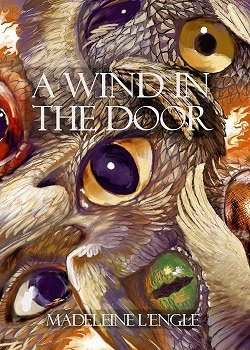
Book Review: A Wind in the Door

“There is war in heaven, and we need all the help we can get. The Echthroi are speeding through the universe. Every time a star goes out another Echthros has won a battle. A star or a child or a farandole—size doesn’t matter…the balance of the entire universe can be altered by the outcome.”

In the Newberry-winning novel A Wrinkle in Time, Madeleine L’Engle introduced readers to Meg Murry, her younger brother Charles Wallace, and their friend Calvin O’Keefe when the three were called upon to rescue Meg’s father from a monstrous, disembodied force that sought to absorb all creatures with free will. Now, in the second book of L’Engle’s Time Quintet, Meg and Calvin are once again visited by magical beings that need their help—this time to save Charles Wallace’s life.

L’Engle’s novels are often categorized as fantasy, but contain an interesting and unusual blend of science/sci-fi and spirituality; A Wind in the Door is no exception. Drawing from the Bible, L’Engle introduces the concept of the Echthroi—fallen angels who are the major destructive force in the universe. They are ripping holes in the sky, spreading darkness and nothingness, and they are responsible for Charles Wallace’s growing weakness and palor as well.

At the beginning of A Wind in the Door, it is revealed that the extremely intelligent and intuitive Charles is steadily growing more and more ill; his mother, who is a renowned biologist, believes that his illness has something to do with his mitochondria. She sets to work in her lab, trying to understand his condition, while Charles and Meg’s physicist father is away consulting with other scientists about some potentially dangerous occurrences in outer space. L’Engle uses these circumstances to place the children in a typical situation of Children’s Literature: because of their parents’ limited understanding and availability, the responsibility to save Charles Wallace falls to Meg and Calvin.

Thus begins the adventure narrative, which involves fighting the agenda of evil spiritual creatures with both the knowledge of science (or rather, L’Engle’s version of science) and the great power of love. I’m not really fond of the author’s reoccurring love-conquers-all message; it’s a little too simplistic, even for Children’s Literature. But I enjoy that the cheribum Proginoskes is also based on a creature from the Bible—the many-winged, many-eyed seraphim in Isaiah.

Proginoskes is sent to partner with Meg; together, the two must face three tests in order to defeat the Echthroi and save Charles Wallace. Although Calvin and several others will play a role as well, Meg and Proginoskes must make a special connection—something that is difficult for Meg at first because of the cheribum’s alarming appearance. But she must learn to trust and love Proginoskes in order to save her little brother; she must learn to “kythe” with him, which is essentially a type of telepathic communication. For the sake of Charles Wallace, Meg must open herself up to a creature that is terrifying in appearance and seems wholly unlike herself.

While re-reading the first two novels in L’Engle’s Time Quintet, it occured to me that Meg is something of a weak and immature character, always wishing that someone else would come along and save the day. This bothered me as I was reading, doubly so because this female character was created by a woman. I want my female characters to be strong and heroic, but Meg is rather snively and whiny, always crying and hiccupping, then having to polish her glasses once they’ve become streaked with her tears. She is often both frightened and frustrated, and always wants a male to come in and take the lead. In A Wrinkle in Time, she is at first convinced that if she and the others can just find her father, Dr. Murry will be able to set everything right, and she is painfully disappointed when he isn’t capable of facing the monstrous IT in order to save Charles Wallace. In the end, it is she who has to return to the planet Camazotz to rescue her brother. Even after this empowering experience, though, Meg continues to be a very anxious and hesitant person, often wishing for the comforting presence of her sort-of-boyfriend Calvin. In A Wind in the Door, she also wants the Teacher Blajeny to handle the Echthroi, instead of having to face the three tests with Proginoskes. To be fair, I wouldn’t want to face off with fallen angels either, but I still found myself wishing for a slightly more stalwart heroine.

I also realize, though that Meg’s weakness is essential to the story – because A Wind in the Door is not simply about saving Charles Wallace, but about how our heroine must overcome her selfishness and immaturity in order to defeat the Echthroi. Meg, who is so often misunderstood by her peers and teachers, must learn to love others who are very different from her—both Proginoskes and the disagreeable Mr. Jenkins—in order to partner with them. Although an adolescent’s typical desire is to first be understood by others, Meg must overcome that desire; she must be the mature one who reaches out to understand those around her. Once she is able to look past her own prejudices and love those that at first seem unlovable, a more mature Meg must then help Calvin and Proginoskes convince another young character to “deepen”—another word for his species’ maturation. Charles Wallace’s survival and recovery ultimately depends on the willingness of both Meg and this secondary character to accept the responsibilities of an adult, whether or not they feel that it is time to grow up.

The novel is steeped in the language and trappings of sci-fi, which I must admit that I find less easy to swallow than pure fantasy for some reason. I find L’Engle’s descriptive imagining of the world inside a mitochondrion to be quite beautiful, but the fact that a great amount of the novel is spent explaining this and that pseudo-scientific concept can become quite a drag, too. And as I already stated, the “love connects the entire universe” and “love conquers all” messages are a little too simplistic and touchy-feely for me to enjoy L’Engle’s novels as much as I enjoy Lewis’s Chronicles of Narnia. (I can’t help but continue to compare the two.) Ultimately, though, I really appreciate the way that L’Engle forces the characters to accept responsibility for more than themselves. Whenever I read The Time Quintet, I find myself chafing though most of the novel, then suddenly having an “ah-ha!” moment and being glad that I read the book. So don’t let my bit of bah-humbug stop you from reading A Wind in the Door—especially if you enjoy science fiction. Even if you don’t, it’s still a great read for kids and even a fairly enjoyable one for adults.

Thursday, January 20, 2011

Book Review: A Wrinkle in Time

While I eagerly wait for Amazon to deliver my copy of 2011 Newbery winner Moon Over Manifest, it feels like an appropriate time to review a few other recipients of that award. Because When You Reach Me, the 2010 recipient that I reviewed on January 16, directly references Madeleine L’Engle’s Newbery-winning A Wrinkle in Time, I thought it would be fun to re-read and review it, along with the rest of L’Engle’s Time Quintet.

A Wrinkle in Time begins very much like many other children’s adventure stories: with an unhappy adolescent. Meg Murry feels unattractive with her braces and glasses, her grades are steadily dropping, and she’s getting into fights at school. Her father went away on a business trip and never came back, and now rumors are flying around town that Dr. Murry has deserted his family for another woman – an idea that Meg knows just isn’t true. Dr. Murry is a famous physicist who works for the government; she believes that he has disappeared because something awful happened to him while he was performing experiments. With all these concerns weighing on her mind, Meg is entirely miserable, and readers will empathize with how difficult her life has become. One scene from the novel that I particularly appreciate is the confrontation that the stubborn Meg has with her principal; you get the sense that perhaps the man might have good intentions, but that Meg is so used to dealing with people who want to ridicule her that she can no longer accept help or friendship from anyone outside of her family.

Then one day, three magical beings calling themselves Mrs. Whatsit, Mrs. Who and Mrs. Which arrive to inform Meg and her gifted little brother Charles Wallace that their father is in serious danger. There is a mysterious shadow that is taking over different worlds in their enormous universe, and Dr. Murry has been imprisoned by this dark force; the three strange messengers have come to transport Meg, Charles Wallace, and their new friend Calvin off on a journey to rescue her father. After traveling from planet to planet and witnessing for themselves the way that the shadow is advancing upon various worlds, they arrive on the planet Camazotz, unsure of how to free Dr. Murry and by determined to prevent the shadow from swallowing Earth.

This is, of course, a rather blatant religious message—the dark shadow, creeping across the surface of the planet and overtaking the hearts and minds of each person, is clearly a depiction of spiritual evil: “Above the clouds which encircled the mountain, [Meg] seemed to see a shadow… she knew that there had never been before or ever would be again, anything that would chill her with a fear that was beyond shuddering, beyond crying or screaming, beyond the possibility of comfort.”

But although several characters make a habit of quoting the Bible, this novel isn’t your run-of-the-mill Christian allegory. Most notably, A Wrinkle in Time does not directly represent God or Christ, the savior of mankind. Throughout such novels as C.S. Lewis’s The Chronicles of Narnia, for example, the Lion Aslan symbolizes both God the Father and Jesus Christ at different times, and his help is absolutely necessary for his subjects to conquer the forces of evil. But in A Wrinkle in Time, Mrs. Whatsit and her companions only deliver the children to the planet Camazotz and then inexplicably cannot remain there with them. Meg, Charles Wallace and Calvin must act on their own to save Dr. Murry and defeat the monstrous IT. This suggests that a savior is not necessary for spiritual redemption, and many traditional Christians have rejected L’Engle’s novels because her writings are infused with unorthodox beliefs like these.

Although these spiritual concepts are the foundation for many of the characters’ actions in A Wrinkle in Time, you do not have to be a religious person to enjoy this novel. The story is a sufficient combination of sci-fi, fantasy and spirituality to be an entertaining adventure narrative. There are also some insightful moments, such as the passage where Meg must try to explain the concept of seeing to some sightless creatures:

“What is this dark? What is this light? We do not understand. Your father and the boy, Calvin, have asked us [about these things], too. They say that it is night now on our planet, and that they cannot see. They have told us that our atmosphere is what they call opaque, so that the stars are not visible, and then they were surprised that we know stars, that we know their music and the movements of their dance far better than beings like you who spend hours studying them through what you call telescopes We do not understand what this means, to see.”

“Well, it’s what things look like,” Meg said helplessly.

“We do not know what things look like, as you say,” the beast said. “We know what things are like. It must be a very limiting thing, this seeing.”

Just as with this conversation, Meg and her traveling companions encounter several beings who help them to understand their universe in different ways; these are not only insights that they need to complete their rescue mission, but to live more wisely on their own planet once they return home.

But although I enjoy these elements of the story, I must confess that some of the novel’s events seem contrived to me and the characters are not as well-developed as I would personally prefer. The depiction of IT as a writhing, seething out-of-body brain and the love-conquers-all message are both a bit too much for me to swallow with a straight face. (Not to mention that in this latest re-read, I kept picturing the extremely intelligent and well-spoken five-year-old Charles Wallace as Stewie from Family Guy, which was more than a little bit disquieting.) So although this childhood favorite is often enchanting, A Wrinkle in Time sometimes falls a little flat for me in comparison to Lewis’s Chronicles of Narnia. That could also be because I grew up reading and re-reading Lewis’s series and didn’t discover L’Engle until I was nearly twenty years old, though. I can certainly see how and why this novel could be an engrossing and magical experience for many readers, so although it is not one of my absolute favorites, I would recommend checking it out, particularly if you have an interest in novels about time travel.


Note: this post participates in the Weekly Geek January 14, 2011 Challenge.
Related Posts Plugin for WordPress, Blogger...