Once upon a time, I earned a Master's Degree in Literature and was a Professor of Literature and Composition. I had a wonderful time writing my Master's Thesis about Children's and Young Adult Literature, and I considered earning a Ph.D. so that I could continue to pursue the written word, including British, American, Latin American and other Global Literatures, Children's and Young Adult Literature, all types of genres and occasionally even poetry. But life takes you in unexpected directions, and so now I am working for a non-profit agency (you can read about that on my other blog, A Little Bit of Wonder). Although my job keeps me too busy to post as many book reviews as I would like, Recommended Reading is a place where I can continue to share my literary discoveries and knowledge as time allows.

Please note that I post reviews for books that I recommend reading, just like the blog title says. This means that I typically won't post a review for a book that I completely dislike. This isn't because I shy away from making negative comments, but rather because I don't want to waste your time or mine (I won't even bother to finish a book if it's not any good). For more on this, see the explanation of my Rating System.)


Showing posts with label Dystopian Literature. Show all posts

Friday, February 25, 2011

Book Review: The Giver

Note: I list a lot of details from the dystopian world of The Giver in this review, but I have tried to refrain from giving up anything that Lowry includes as a surprise reveal in the novel, and as always, I do not spoil the climax/end of the novel.

When I picked up Lois Lowry’s Newbery-winning novel The Giver for a re-read, I was reminded of something that C.S. Lewis once wrote: “No book is really worth reading at the age of ten which is not equally (and often far more) worth reading at the age of fifty.” I am often struck by the truth of this statement when I re-read classic works of children’s literature, especially when I return a book that I haven’t touched in at least a decade. The memories of a novel come rushing back; the significance that the story held for me in my childhood intermingles with my “adult” reactions, adding layers to the experience of reading the book. Lewis’s quote came particularly into my mind as I re-read The Giver, since I have actually experienced the death of loved ones and wrestled personally with some of the questions in the book since last reading Lowry’s novel. Now, The Giver is no longer just a well-written work of dystopian fiction, but a reflection on events that are personally significant.

I remembered the basic plot of the novel: twelve-year-old Jonas is living in what seems to be an ideal society where no one experiences pain of any depth, but once he is chosen to be “The Receiver of Memory” for his community, he begins to learn the price of that idyllic existence. While his friends and peers start training for their new occupations as Doctors, Teachers, Nurturers and Recreational Assistants, Jonas begins to meet with the previous Receiver. The elderly man’s job is now to pass on the memories to young Jonas – and so the man becomes The Giver of the novel’s title. Through Jonas’s relationship and work with The Giver, he begins to perceive many new things about the world around him – both beautiful and painful things, the emotions and experiences that make us fully human.

But as Jonas learns about these many exciting, wonderful experiences, he realizes that his family and members of his society are completely unaware of them. They do not understand the depth of both affection and sexual love that human beings are able to feel for one another because they are medicated to remove sexual urges. His society has sought to eliminate the horrors of physical pain and emotional anguish, but have also robbed themselves of the emotions at the opposite end of the spectrum – joy and passion. But The Giver must teach Jonas about physical pain and death in its many forms; the knowledge and experiences of these things will now be his burden to carry in order to shelter the community from such horrors. But once Jonas realizes how the people of his society have handicapped themselves, he wants to devise a way to restore memories and emotions to the individual members of the community so that they can once again experience human passions.

The society that Lowry has created is becomes more and more obviously insidious as the novel progresses. “Sameness” stretches across all aspects of their community: the society dictates acceptable behaviors, occupational choices, spousal selection, family planning. Everything is masterfully controlled – even climate, genetics and death.

As I re-read the novel, I was particularly fascinated to notice the community’s use of language; there is often a prescribed script which the members of this society must follow and so it is through language that the people police themselves and control is maintained. As someone who loves words and phrases and stories, I noticed more and more the ways that the social and individual narratives were controlled: the use of a number instead of a name when a child misbehaves, a name designated as “Not-to-Be-Spoken” if a person of that name has been a particular disgrace, the prescribed apologies and standard responses for every social situation, the required family ritual of dream-telling, the importance that is placed on the precision of language – and Jonas’s resulting preoccupation with the accuracy of his expressions. All of these things create parameters for the individuals of this society, which shows just how powerful language and narrative can be. The creators of this society felt that they must standardize even a simple apology in order to ensure safety and happiness.

It is obvious that while this “sameness” was intended to provide safety and happiness, it has removed people’s free choice and the vibrancy of their lives – yet upon re-reading The Giver at this juncture of my life, I must admit that there were certain aspects of this society that appealed to me. Last year, I watched both of my very special grandparents rapidly deteriorate physically, then die – and so it seemed somewhat attractive to me that in this society, the elderly were treated with so much respect, cared for so diligently and made so comfortable, then “released” before they started to suffer. Euthanasia is a touchy subject – one of many in The Giver. Reading the novel again, I have realized just how complicated many of these issues can be.

But The Giver does not attempt to preach – it simply presents these very complicated social issues in a context that readers can see the trade-off. There are reasons that this society has relinquished many of their rights – and in certain ways, they are better off. I don’t think that they just seem to be better off – they are better off. It is not a total illusion. But ultimately, we have to ask ourselves, is the illusion worth it? The answer to most of us, even with all the attractive aspects of this society, is still a resounding “no.”


This post participates in Presenting Lenore's Dystopian February Reading Challenge.

Sunday, February 20, 2011

In My Mailbox: A Small Stack of Dystopian Novels

In My Mailbox is a weekly meme started by The Story Siren in order to give extra exposure to the books that bloggers have recently acquired. Book bloggers show off novels that they have recently purchased/received (not necessarily in the mail literally) before they read and review them. This way, we can share our bookish excitement with each other (because our friends/boyfriends/husbands/families don’t really care) and help to build interest for the novels amongst our followers.

This meme has spread to over two hundred participating blogs – so if you visit The Story Siren’s weekly entry, you can find links to everyone’s acquisitions. This is great if you’re looking to find some new reading to add to your TBR (To Be Read) Pile… it may not be so great if your TBR Pile is already gigantic!

This week, the book fairy (also known as the mail man) brought me a box of Dystopian goodies from Amazon… I had been planning on participating more frequently in Presenting Lenore’s Dystopian February Reading Challenge – but I’ve been so busy that I haven’t gotten to many Dystopian novels and the month is almost over! I’m hoping I can make time for at least one or two of these before the beginning of March, which will kick-off my Six Aussie Books in Six Weeks Reading Challenge. So here’s what the book fairy brought me:

The Windup Girl b Paolo Bacigalupi
The Dream of Perpetual Motion by Dexter Palmer
The Year of the Flood by Margaret Atwood
The Maze Runner by James Dashner

Now let me fill you in on a few details for each of these novels:

After reading and enjoying Paolo Bacigaliupi’s Printz Award-winning Ship Breaker a few weeks ago, I was curious to read more of his work. He actually just came out with a novel called The Alchemist at the end of January, but Amazon has informed me that it will take something like six weeks to ship that – I guess everyone is interested in Bacigalupi now. Meanwhile, I ordered The Wind-Up Girl, a novel that he published in September 2009. Just like Ship Breaker, The Wind-Up Girl takes place during “a post-oil era of rising sea levels and out-of-control mutation” (Publishers Weekly), but Girl is set in Bangkok, Thailand instead of New Orleans, like Ship Breaker. The cast of characters include an Agribusiness (genetically modified plants) manager and a captain of the Thai Environment Ministry, refugees from China, and an incredibly seductive prostitute who is the result of Japanese genetic engineering and ends up inciting a civil war. It sounds like Bacigalupi has imagined another interesting, frightening world when writing this novel, complete with hackers who can modify plant DNA and create havoc. I haven’t seen this book reviewed on any of the book blogs that I regularly frequent, but I did find a random review that stated that there were “allusions to the idea that things grown simply for beauty were no longer possible and things grown at home to feed yourself were just downright dangerous to your health… imagine a world where you could not garden and you realize that this book is not just sci-fi but horror as well.” So Wind-Up Girl is Cyberpunk/Sci-Fi/Dystopian/Horror? I’m pretty excited.

I’ve been told I need to try reading Steampunk novels, so after seeing Dream of Perpetual Motion by Dexter Palmer sitting out on several Barnes & Noble book tables, I decided to give it a shot. The Publisher’s Weekly review sold me, though. If this doesn’t sound like a great way to introduce myself to the Steampunk genre, I don’t know what does:

“In a steampunky alternate reality, genius inventor Prospero Taligent promises the 100 kids he's invited to his daughter Miranda's birthday party that they will have their heart's desires fulfilled. When young Harold Winslow says he wants to be a storyteller, he sets in motion an astonishing plot that will eventually find him imprisoned aboard a giant zeppelin, the Chrysalis, powered by Taligent's greatest invention, a (probably faulty) perpetual motion machine. As Harold tells his story from his airborne prison, a fantastic and fantastical account unfolds: cities full of Taligent's mechanical men, a virtual island where Harold and Miranda play as children, the Kafkaesque goings-on in the boiler rooms and galleries of Taligent's tower. Harold's narration is interspersed with dreams, diary entries, memos and monologues from the colorful supporting cast, and the dialogue, both overly formal and B-movie goofy (I'm afraid the death rays are just a bunch of science fiction folderol), offers comic counterpoint. This book will immediately connect with fans of Neal Stephenson and Alfred Bester, and will surely win over readers who'd ordinarily pass on anything remotely sci-fi.”

I’m also looking forward to reading Atwood’s newest novel The Year of the Flood, which is about several very different survivors of a natural disaster that permanently alters Earth’s eco system: Ren, a young trapeze dancer locked inside the high-end sex club Scales and Tails, and Toby, a member of the religious group God's Gardeners, who is barricaded inside a luxurious spa where many of the treatments are edible. Atwood has stated that she began wondering “What kind of people might undertake the challenge [of reversing the damage to the planet]… unless you believe our planet is worth saving, why bother? So the question of inspirational belief entered the picture, and once you have a set of beliefs--as distinct from a body of measurable knowledge--you have a religion. The God’s Gardeners appear briefly in Oryx and Crake, but in The Year of the Flood, they’re central.” This sounds really interesting to me – in Ship Breaker, Paolo Bacigalupi had invented a religion that included “the Rust Saints,” an interesting blend of environmental deities and voodoo that I would have been interested to learn about more. I’m a huge fan of Atwood’s older religious dystopian novel The Handmaid’s Tale, so I’m eager to see what she’s come up with this time. I probably won’t get to The Year of the Flood too quickly, though, because it is the second in a series – and it’s been way too long since I read Oryx & Crake, so I’ll have to make time to read the two together.

Finally, I’ve found a lot of book reviews that enthusiastically praise The Maze Runner by James Dashner, so I won’t get in to much detail about the novel right now. But I will say that I’m very interested in the idea that there are a bunch of teenage boys who must learn to survive in “a completely enclosed environment, subsisting on their own agriculture” and few other supplies. I feel like maybe I should take the opportunity to re-read Lord of the Flies around the same time as when I read Maze Runner.

I’m looking forward to reading all these novels, even though I know that I won’t get to some of them for a while… Have you read any of these? What would you recommend that I pick up first?

Monday, February 7, 2011

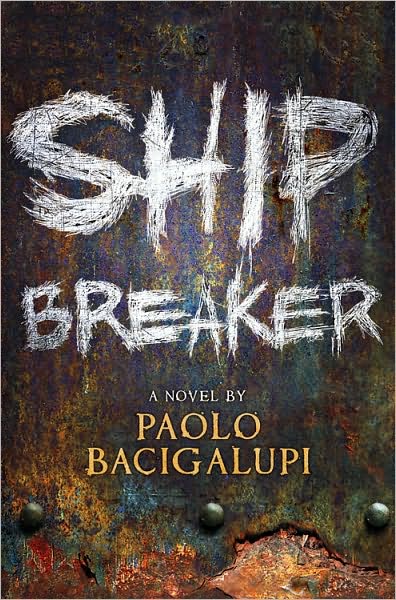
Book Review: Ship Breaker

Paolo Bacigalupi, the author of the 2011 Michael L. Printz Award Winner Ship Breaker, drew his ideas for the novel from recent concerns with global warming, environmental issues in the Gulf Coast region, and knowledge of ship-breaking in Bangladesh. By transposing the world of the ship breakers to the more familiar setting of the United States, he hopes to help his readers examine the possibilities of the world we will all face if we use up the earth’s resources.

Watch Bacigalupi talk about his desire to write about a post-oil world, where people must deal with the consequences of global warming:


While there is a particular ominous message behind Ship Breaker, the novel never feels didactic or heavy-handed because Bacigalupi spins a fast-paced adventure. Ship Breaker focuses on Nailer, a scavenger who helps to pull apart the old-world oil tankers that are run-aground on the Gulf Coast. He crawls and slithers into the ducts of the abandoned ships, pulling out copper wiring and other bits of valuable metal. Soon he will be too big and too heavy to crawl through the duct systems, though, and without regular work on the light crew, he’ll be forced to fend for himself out on the dangerous beaches. Though his loyal friend Pima and her mother Sadna are fiercely protective of him, they won’t be able to help him get a spot on heavy crew – he isn’t strong enough to pull apart the outer hulls and massive pipes of the shipwrecked tankers. Nailer hasn’t given much thought to his future, though, because surviving the dangers of his current job and his violent, drug-addicted father take up most of his time.

After a particularly close brush with death, though, Nailer is lucky enough to come across an opportunity to escape the beaches of the Gulf Coast. When he and Pima discover a wealthy young girl trapped in a shipwreck, she seems to be their ticket to a new life. The daughter of an important shipping magnate, Nita tells them that she is being hunted by her father’s enemies, who want to use her as leverage to gain control of her family’s global corporation. If they will help her make contact with employees who remain loyal to her father, though, there will be a reward.

While Pima chooses to stay behind with her mother, Nailer decides to help Nita escape – burning all bridges with his violent father and hoping that he will be able to find a new life in the North. And so, while the first part of Ship Breaker explores the violent, seedy world of the scavengers and the Gulf Coast beaches, the second part of the novel follows Nailer and Nita as they set out on their journey through Orleans I and Orleans II to find someone who will take Nita back home to her family – and hopefully provide a place and a new life for Nailer as well.

Most of the novel is fast-paced and very involving, so I think that I would have enjoyed the story no matter the setting – but the way that Bacigalupi slowly unfolds his vision of a post-oil world is fascinating. The dystopian setting lends itself to the events of the novel in such a way that Nailer, Pima and Nita’s adventures feel fresh and unusual to me, although I must admit that I am not very well-read when it comes to science fiction (yet). I’ve read and enjoyed other dystopian novels, but this is the first that feels quite so tangibly connected to the world in which we are currently living – over the past five years, we have watched on the newsreel as New Orleans and the Gulf Coast region have been hit first with Hurricane Katrina, then the BP oil spill in 2010. Connecting so closely with a work of dystopian literature is a little bit creepy – but also thoroughly engrossing.

Because we have had the images of devastated New Orleans so recently before us, it is not difficult to imagine this section of the country as hell-on-Earth; I’m impressed, though, with the way that Bacigalupi develops the details of this harsh new America. The residents of New Orleans have always been known as colorful and superstitious, so it is not surprising that in the wake of such extreme environmental disasters, a new society would spring up that is similarly religious/superstitious. Nailer’s world is filled with people who are both cruel and religious, who are willing to turn to both violence and the Fates in order to survive. It is this picture of a desperate society reduced to brutality that makes Nailer such a sympathetic character – he is one of the few that still dreams, still values human life, still seeks to understand those around him. As Bacigalupi pulls you along on this fast-paced adventure, you will likely find yourself hoping for Nailer’s survival not only as an individual, but as a symbol compassionate humanity triumphing over the poverty, destruction and desperation of society.


This post participates in Presenting Lenore's Dystopian February Challenge. Drop by her website to read more about it and/or join up!
Related Posts Plugin for WordPress, Blogger...